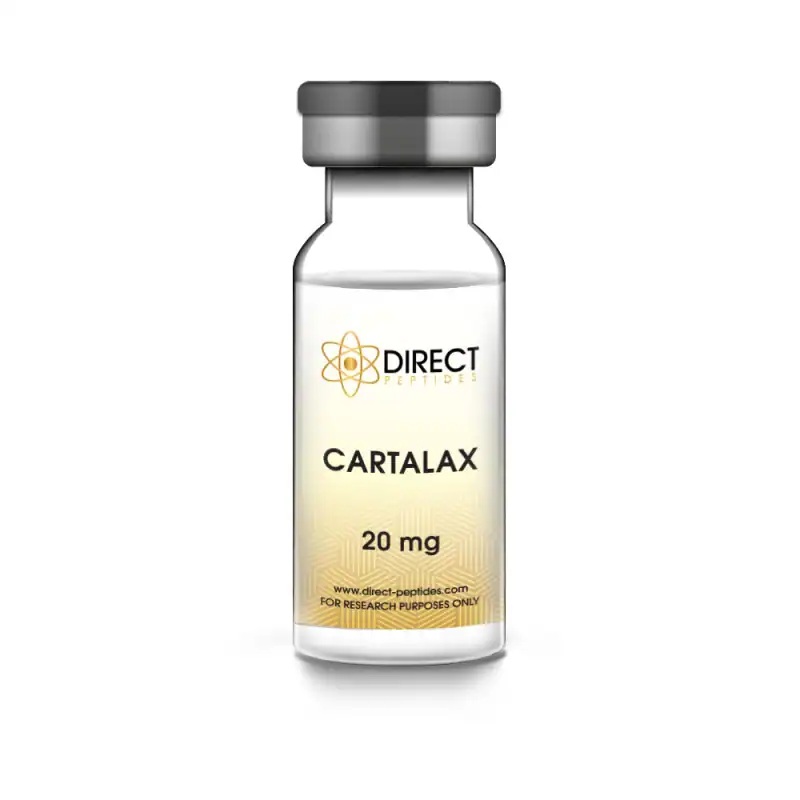
Buy Cartalax Peptide Finland
Cartalax is a short-chain peptide studied for its support of cartilage cell signaling, extracellular matrix stability, and reduction of joint-related inflammation. These properties make it a promising tool in arthritis and cartilage health research.
Shop our Full Range of Cartalax Peptides
-
NEWCartalax Peptide Vial
£41.50 – £50.48Price range: £41.50 through £50.48 This product has multiple variants. The options may be chosen on the product page
What is Cartalax?
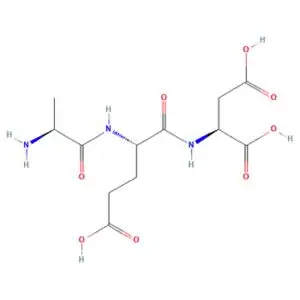
Cartalax is a synthetic peptide bioregulator specifically designed to support the musculoskeletal system. Composed of three amino acids: alanine, glutamic acid, and aspartic acid, it mimics peptides naturally found in cartilage tissue. Its primary purpose is to normalise the metabolism of cartilage and bone tissues.
By stimulating collagen and extracellular matrix synthesis, Cartalax helps repair damaged cartilage and improve joint resilience. It is often utilised to enhance mobility, reduce discomfort associated with ageing or injury, and support overall joint function. This targeted approach makes it a key bioregulator for maintaining long-term structural health in the spine and joints.
Cartalax Mechanism Of Action
Cartalax helps keep cartilage and joints healthy in several ways. It affects peptide signaling pathways that control collagen and tissue elasticity, which are important for repairing and strengthening cartilage. Cartalax also stimulates chondrocytes, the cells that maintain and rebuild cartilage, helping repair damage and support joint function.
It activates SIRT1, a protein that can block NF-κB activity, which helps lower inflammation and slow down cell aging. Cartalax also reduces p53 signaling, delaying cell aging and preventing early cell death. Together, these actions help maintain healthy tissues and support the musculoskeletal system.

Structure of Cartalax
Sequence: H-Ala-Glu-Asp-OH
Molecular Formula: C12H19N3O8
Molecular Weight: 333.29 g/mol
PubChem CID: 87815447
What Are The Research Benefits of Cartalax
The regulation of gene expression: Cartalax, a synthetic tripeptide, acts as a potent bioregulator by directly influencing gene expression. Studies show that short peptides (2–7 amino acids) can enter cell nuclei and interact with nucleosomes and DNA [1]. Through these interactions, peptides such as Cartalax regulate DNA methylation, an epigenetic process essential for controlling gene activity. This regulation normalises protein synthesis and metabolic processes in cartilage tissue. By modulating these genetic pathways, Cartalax promotes tissue repair and resilience, supporting musculoskeletal health and helping to counteract age-related degeneration [2].
Supports Cartilage & Joint Tissue: Cartalax supports cartilage and joint tissue by addressing the limited regenerative capacity of cartilage [3]. Research highlights the potential of short peptides in tissue engineering and osteoarthritis therapy. Specifically, the AED peptide has been shown to stimulate chondrogenic differentiation, the process by which stem cells become cartilage cells [4]. It achieves this by activating the expression of key genes and protein synthesis, such as SOX9 and type II collagen, even in ageing cells. This targeted action promotes the restoration of cartilage tissue, enhancing joint function and resilience against age-related wear and tear [5].
Effects on Cellular Aging and Stress Pathways: Cartalax demonstrates significant potential in influencing cellular ageing and stress pathways. Studies indicate its ability to reduce senescence markers like p53, while simultaneously enhancing the activity of SIRT1 and SIRT6 proteins linked to genomic stability and mitochondrial function [6]. In human mesenchymal stem cell models, AED has been shown to modulate the expression of key genes involved in ageing, such as IGF1 and NFκB. By regulating these genetic pathways and potentially managing reactive oxygen species (ROS), Cartalax supports cell survival and exerts geroprotective effects, promoting resilience against cellular stress and premature degeneration [7].
Effects on Fibroblasts and the Extracellular Matrix: Cartalax plays a significant role in modulating fibroblast activity, the cells responsible for producing connective tissue matrix. Research using immunofluorescent confocal microscopy indicates that Cartalax enhances fibroblast proliferation, evidenced by increased expression of markers like Ki-67 and CD98hc, which typically decline with age. Crucially, it inhibits the synthesis of MMP-9, an enzyme that degrades the extracellular matrix (ECM) and increases during cellular aging. Furthermore, Cartalax suppresses caspase-dependent apoptosis, promoting cell survival. These findings suggest Cartalax has substantial potential for connective tissue remodelling and regeneration, effectively countering age-related degradation in skin and joint fibroblasts.
Buy Cartalax for research online today!
Cartalax Peptide Quality Assured
At Direct Peptides, you can buy Cartalax with a guaranteed purity of 99% or higher. Every batch is rigorously tested to meet the highest standards for quality and effectiveness. This ensures you can trust our Cartalax peptide products to deliver consistent and reliable results for your research needs.
Summary of Research Applications
- Supports cartilage health.
- Enhances joint mobility.
- Promotes tissue repair.
- Reduces inflammation.
- Increases resilience against cartilage damage.
- Delays cellular aging.
Frequently Asked Questions (FAQs) about Cartalax Peptide
Is it legal to buy Cartalax?
The legality of buying Cartalax varies by country. In many areas, including the United States and the European Union, Cartalax is not approved for human use and is typically sold for research purposes only. Using it in humans or animals may violate federal, state, or local laws, such as the U.S. Federal Food, Drug, and Cosmetic Act. Always review local regulations and consult a healthcare professional before purchasing or using Cartalax.
Is Cartalax safe?
Cartalax is generally regarded as safe, with studies reporting no significant side effects. Peptide bioregulators aim to support normal bodily functions rather than alter them beyond their natural range.
How should Cartalax be stored?
Store Cartalax in a cool, dry place, away from direct sunlight and moisture. Follow any specific temperature recommendations on the packaging, such as refrigeration, to maintain its stability and effectiveness.
Buy Cartalax Finland for research purposes from Direct Peptides.
References For Further Reading
[1] Khavinson V, Linkova N, Kozhevnikova E, Dyatlova A, Petukhov M. Transport of Biologically Active Ultrashort Peptides Using POT and LAT Carriers. Int J Mol Sci. 2022 Jul 13, Volume 23 (Issue 14), Page 7733.
[2] Khavinson VK, Popovich IG, Linkova NS, Mironova ES, Ilina AR. Peptide Regulation of Gene Expression: A Systematic Review. Molecules. 2021 Nov 22, Volume 26 (Issue 22), Page 7053.
[3] Liu Q, Jia Z, Duan L, Xiong J, Wang D, Ding Y. Functional peptides for cartilage repair and regeneration. Am J Transl Res. 2018 Feb 15, Volume 10 (Issue 2), Pages 501-510.
[4] Linkova N, Khavinson V, Diatlova A, Myakisheva S, Ryzhak G. Peptide Regulation of Chondrogenic Stem Cell Differentiation. Int J Mol Sci. 2023 May 8, Volume 24 (Issue 9), Page 8415.
[5] Myakisheva SN, Linkova NS, Diatlova AS, Polyakova VO, Ryzhak GA. [The influence of peptides on the chondrogenic differentiation of human mesenchymal stem cells during replicative aging.]. Adv Gerontol. 2023, Volume 36 (Issue 3), Pages 383-390. Russian.
[6] Vasily Ashapkin, Vladimir Khavinson, Gregory Shilovsky, Natalia Linkova, et al (2020) Gene expression in human mesenchymal stem cell aging cultures: modulation by short peptides. Molecular Biology Reports. 12 May 2020, Volume 47, pages 4323–4329.
[7] Meiting Li, Tianyun Hou, Tian Gao, Xiaopeng Lu, et al (2018) p53 cooperates with SIRT6 to regulate cardiolipin de novo biosynthesis. Cell Death & Disease, 20 September 2018, Volume 9, Page 941.
Why Choose Direct Peptides Finland?
Buy Cartalax Finland today and discover unrivalled quality with Direct Peptides, your premier source for high-purity research peptides. Setting us apart is our unwavering commitment to scientific excellence and product integrity. We currently offer this specialised peptide in a concentrated 20mg vial, specifically designed to meet the rigorous demands of laboratory investigation.
ALL CONTENT AND PRODUCT INFORMATION AVAILABLE ON THIS WEBSITE IS FOR EDUCATIONAL PURPOSES ONLY.
DISCLAIMER: These products are intended solely as a research chemical only. This classification allows for their use only for research development and laboratory studies. The information available on our Finland Direct Peptides website: https://direct-peptides.com is provided for educational purposes only. These products are not for human or animal use or consumption in any manner. Handling of these products should be limited to suitably qualified professionals. They are not to be classified as a drug, food, cosmetic, or medicinal product and must not be mislabelled or used as such.
Related Posts

Cartalax vs BPC-157: How Do They Compare for Inflammation Relief?
Cartalax and BPC-157 have distinct roles in inflammation research. Cartalax focuses on cartilage cell signaling and matrix stability, supporting studies of joint-related inflammation. In contrast, BPC-157 promotes soft tissue recovery and broader inflammation control in muscles and tendons. These differences underscore their unique contributions to inflammation across various tissues and biological pathways.
Is Cartalax Bioregulator the Future of Arthritis Management?
Cartalax Bioregulator shows potential in arthritis research by targeting cartilage cell function, maintaining extracellular matrix balance, and modulating inflammatory pathways. It helps protect joint health by reducing cartilage degradation and stabilizing structural proteins. Used with peptides such as ARA-290 and Thymosin Alpha-1, Cartalax provides a comprehensive approach to studying arthritis progression and joint degeneration.